Vegetal Sensations: Exploring the Three Sisters
An Installation of Self-guided exercises in Sensory P(Art)icipant Observation
Date: March 24, 2025
Time: 11 am – 4pm
Location: FSS 4004
Organized by Emma Slaney Gose and Nina Barbosa
This interactive one-day installation was organized by PlanthropoLab and OPIRG-GRIPO, during Sociology and Anthropology week (2025) at the University of Ottawa.
Drawing on the work of Natasha Myers, Andrew Causey, and Robin Wall Kimmerer, the installation invited participants to engage with the three sisters through multisensory, kinesthetic, and tactile experiences.
Who are the Three Sisters?
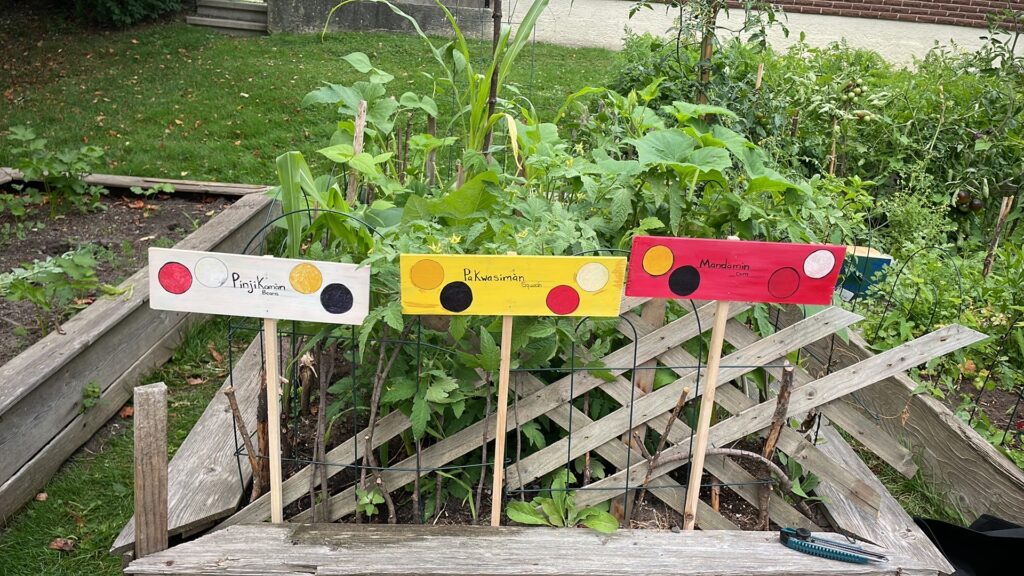
The Three Sisters, corn, beans, and squash, represent Indigenous agricultural knowledge. These crops were traditionally grown together to maximize environmental sustainability and foster mutual support. The beans add nitrogen to the soil, the corn provides structural support for the beans to climb, and the squash acts as ground cover to retain moisture and protect the other crops from pests.
Interactive Stations
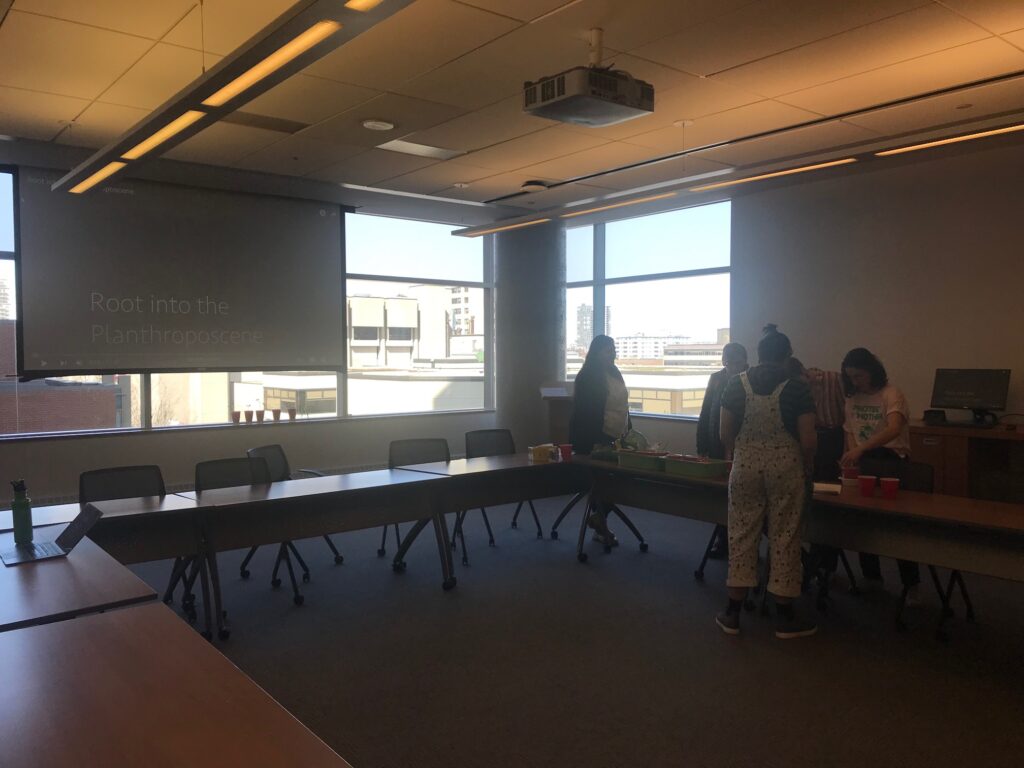
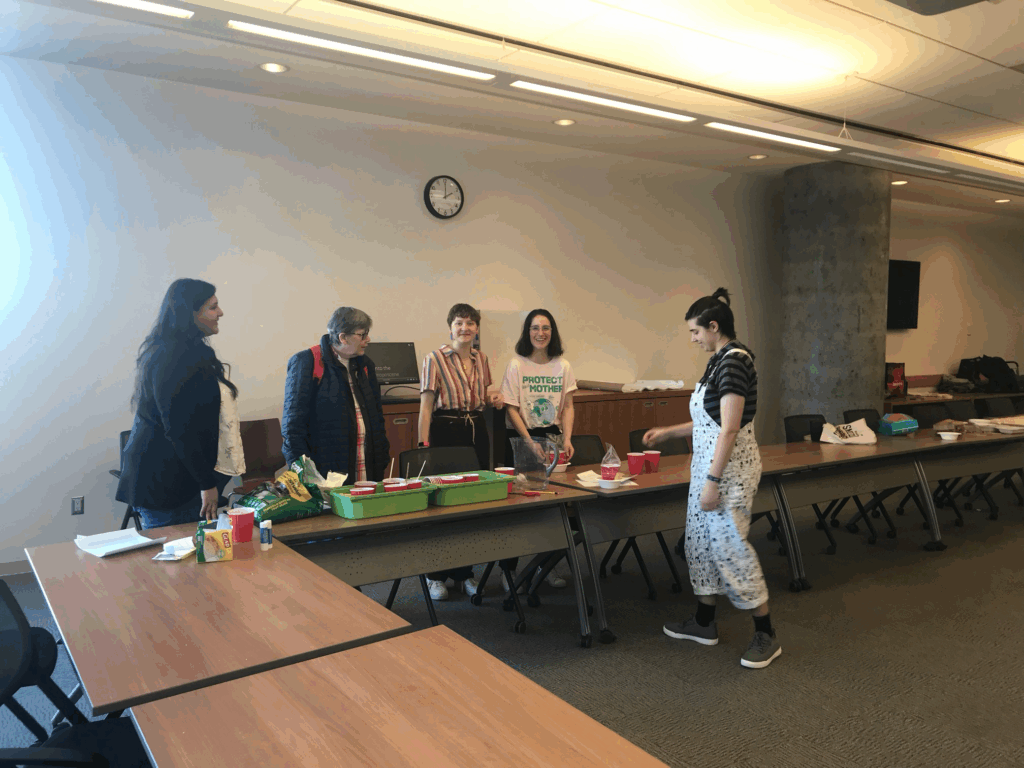
We brought the installation to life in early spring, and while the cold still permeated everything, daylight was steadily increasing. The space we had was a modest conference room, its rows of movable chairs and collapsible tables hinting at its everyday purpose. Yet, for a few hours, we endeavored to transform it into a site of quiet exploration and sensory engagement. We recognized that both time and setting constricted some of our loftier aims- would this not be easier in an outdoor setting, among trees, soil, air and shifting light after all? Perhaps, but why not experiment a bit anyway; seeds germinate in less than ideal conditions all the time. Like a germinating seed, sometimes you must make do with the conditions into which you sprout.
As visitors entered, they were greeted by the looping audio of the Robin Wall Kimmerer’s Three Sisters chapter playing softly through the room’s speakers. This background soundscape invited participants to tune in, to drift between listening and doing, as they moved from one station to another. The rhythm of voices, stories, and sounds created an ambient thread connecting each part of the experience.
On the far wall, a projector played Natasha Myers’ Becoming Sensor in an Oak Savannah on loop. The moving images offered a living counterpoint to the otherwise still space. As participants settled in, they were invited to imagine “Becoming Phototropic,” guided by the practice A Kriya for Cultivating Your Inner Plant. The room became a quiet studio for inner transformation, encouraging visitors to stretch beyond the boundaries of the conference room walls and into a more-than-human mode of sensing.
Station 1: Drawing as Sensorial Transduction
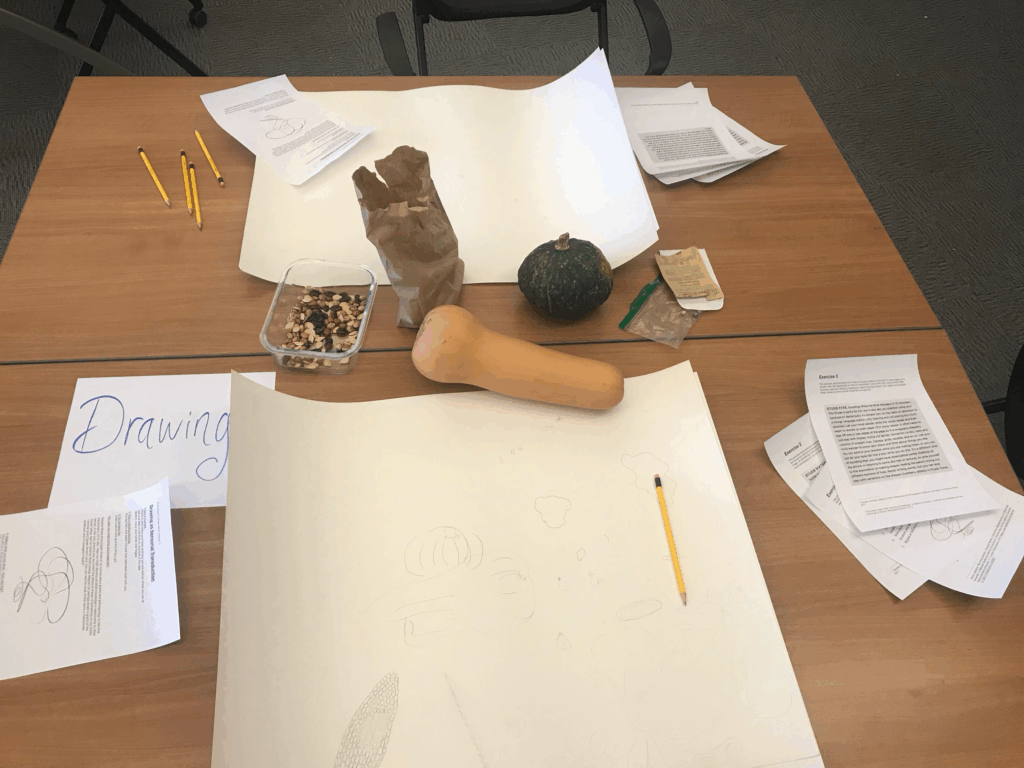
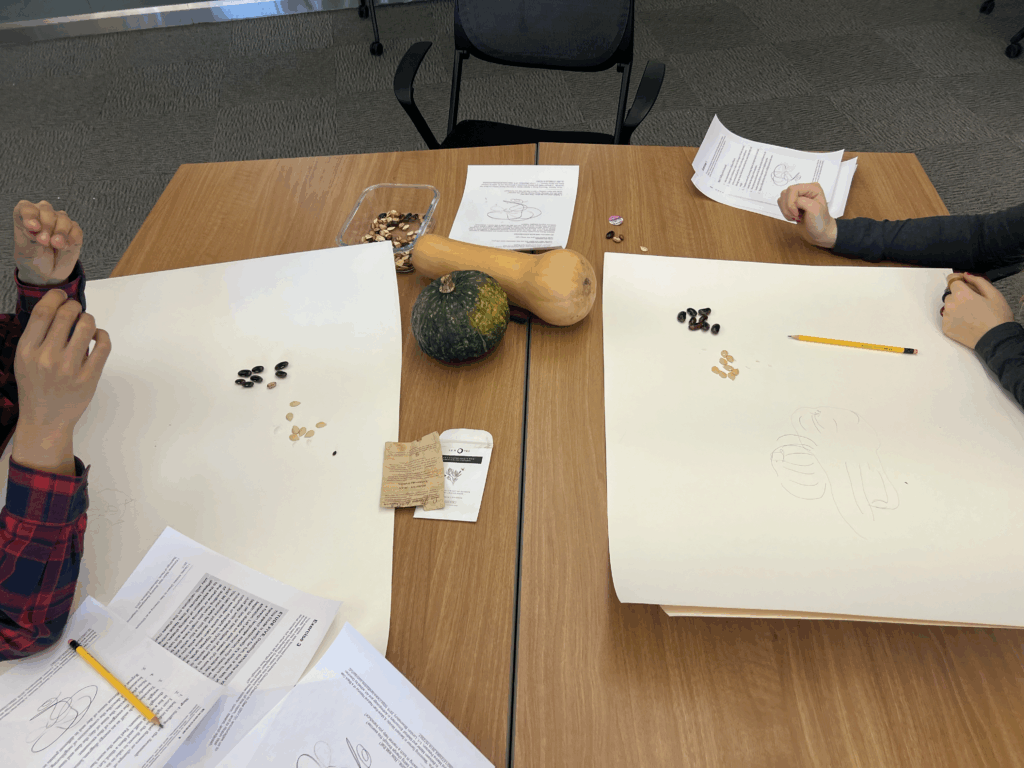
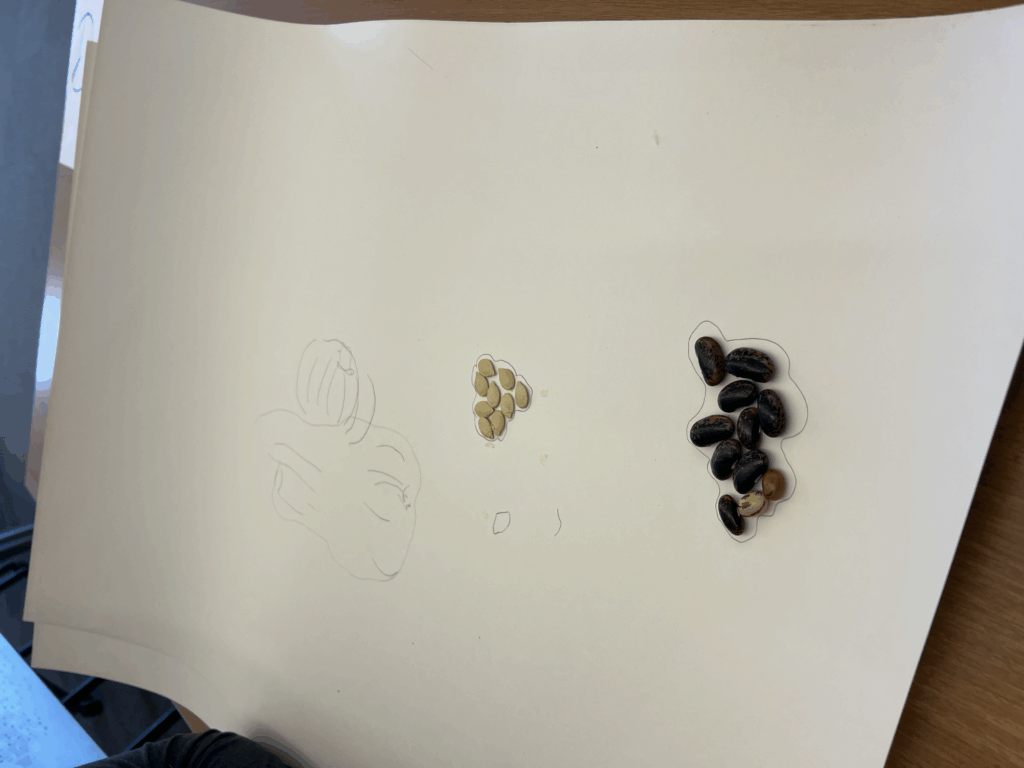
At the entrance of the room, the tables became communal ground, transformed by large sheets of cardboard that stretched across their surfaces like shared soil. These blank canvases invited participants to contribute collectively, layering impressions, gestures, and drawings in an evolving conversation of marks and textures.
Placed carefully atop the tables was a small container filled with seeds: corn, beans, and squash, the Three Sisters. Visitors were encouraged to run their fingers through them, to feel their weight and texture, to connect through touch with the life held in each tiny seed. A homegrown butternut squash rested nearby, its shape and skin offering yet another surface to explore: smooth, ridged, dense.
There were no strict instructions here. Participants were simply invited to respond, to trace the sensation of seed against palm, or the squash in hand, onto the cardboard. Some sketched, while a few sat in silence, hands resting on the paper, eyes closed. The sheets slowly filled with layered expressions, a collaborative act of sensing and making that echoed the interwoven growth of the Three Sisters themselves.

1) Take a moment
- Check-in and notice your body and how you are feeling/ where you are at
- Feel your feet on the floor or your butt in the seat
- Stretch, move your hands and fingers
2) Pick a drawing exercise (see below)
- Peruse them and select the one that resonates most with you.
3) Do the exercise
- Grab a pencil and give this thing a go!
4) In case you need some encouragement…
Natasha Myers encourages those of us curious about plants and anthropology to become transducers ( 2019: 90). Here we might develop situated knowledge in relationship to other beings. In this way, drawing can document the affective impact of something on our bodily tissue/ being. See for instance Myers energy diagram (or perhaps smell-o-gram) of the common plant Queen Anne’s Lace. Can you see the smell of this carrot-y midsummer wildflower and it’s energetic impact?
5) Reflect when you are done – How was that?
- How did your thinking/ being change through this exercise?
- What else might drawing in such a manner help you transduce?
Exercise 1
This exercise is borrowed from Natasha Myers 2019 work “Becoming Sensor in Sentient Worlds”. While she recommends this exercise with wildflowers, it could be done with various plants, environments, and so on. Here we encourage doing it seeds, soil, squash etc.


Exercise 2
This exercise borrowed from Andrew Causey’s Drawn to See (2017), offers this “Eye-is-Hand” technique as method of connect the act of looking to movement. Drawing inspiraton from an image, or something in the room that catches your eye, or even to the process of scanning the room and taking it in, try out the étude below.

Exercise 3
This exercise, also borrowed from Andrew Causey’s Drawn to See (2017), encourages us to doodle. Take this opportunity to listen to the ambient noise of the room, and to Robin Wall Kimmerer read from Braiding Sweetgrass about the three sisters- corn, beans, and squash. What comes out when we let things flow through us?

Station 2: Kinesthetic Attunements – Moving meditation
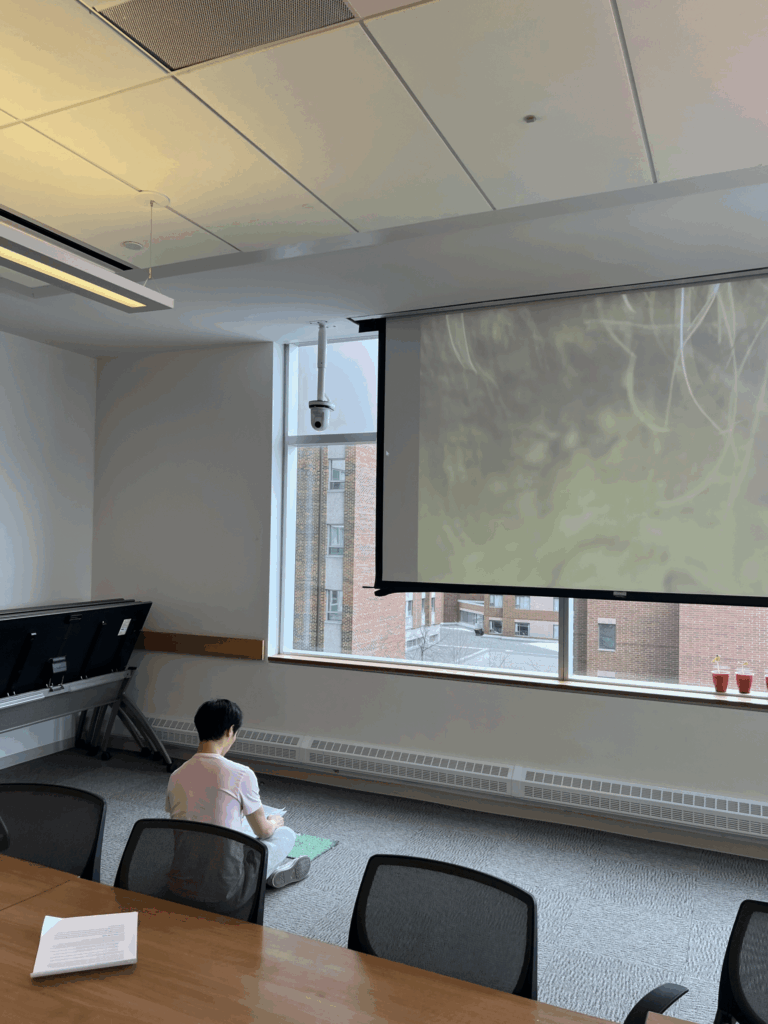
At the back of the room, where sunlight sometimes peeked through the windows and the projector cast soft, flickering images, we created a small sanctuary for movement and stillness. Here, a patch of artificial grass offered a place to ground oneself, either a gentle nudge toward imagining soil beneath bare feet, or a humorous reminder of how much plastic was likely to be underneath them. Regardless, the question of exercise persisted- how do we become plant irrespective (or maybe because) of earthy or concrete/ plastic surroundings?
In this quiet corner, surrounded by the faint hum of the Three Sisters audio and the slow, vegetal movements from the Oak Savannah, participants were invited to explore the concept of Becoming Phototropic. Through this full-body exercise, they practiced turning toward light, perhaps drawn into a motion of anchoring downward, or an extension toward the sunny windows. In this fashion, those who were willing engaged in this act of sensible worldmaking by sitting, standing, stretching or swaying, as the parameters of their skin morphed and dissolved.
In front of them, the three sister seedlings, corn, beans, and squash, stood as living companions. Their presence was more than symbolic; it was a reminder of relational growth. The exercise asked participants not just to observe these seedlings, but to imagine growing alongside them.2

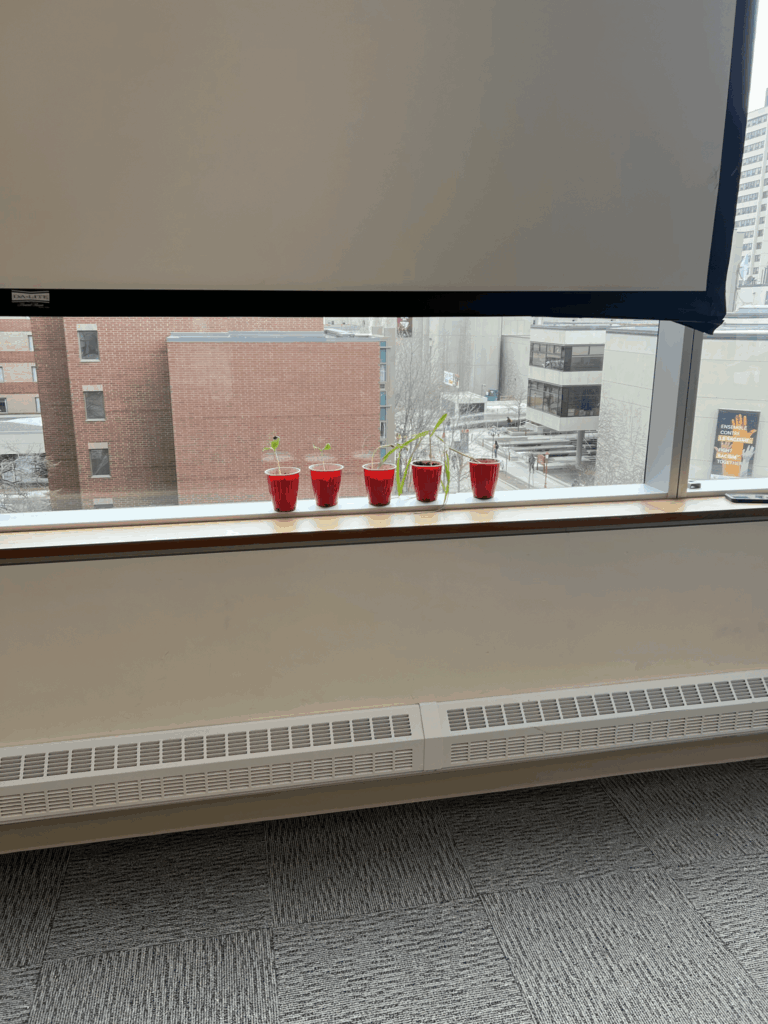
Station 3: The Three Sisters: Self-Guided Seed Germination Station
Understanding the Three Sisters
In “Braiding Sweetgrass,” Kimmerer shares how she first attempted to grow the Three Sisters in her garden. Despite her scientific training as a botanist, her initial planting failed as she approached it purely as a technique rather than as a relationship. The story reminds us that growing these plants is not just about following steps but about understanding the deep connections between them.
The Three Sisters planting method is an indigenous agricultural practice to the Americas where corn, beans, and squash grow together in mutual support:
- Corn stands tall, reaching toward the sun, offering her stalks as a sturdy ladder for the beans to climb
- Beans twine around the corn, strengthening her against the wind while pulling nitrogen from the air to nourish the soil for all three
- Squash spreads her broad leaves below, creating living mulch that retains moisture, prevents weeds, and deters pests with prickly stems
Kimmerer describes this relationship as a perfect model of what a community can become when its members contribute their gifts while receiving what they need. She reflects on how the Three Sisters garden is both practical and sacred, a place where the plants’ gifts are matched by human gratitude and care. This garden teaches us that abundance emerges through cooperation rather than competition.
Part 1: Honoring the Seeds
In “Braiding Sweetgrass,” Kimmerer recounts the Haudenosaunee thanksgiving address, which acknowledges corn, beans, and squash as the Three Sisters who feed the people. She describes how Indigenous gardeners would speak to the seeds, honoring them with gratitude before planting. Seeds were recognized not as commodities but as relatives deserving of respect.
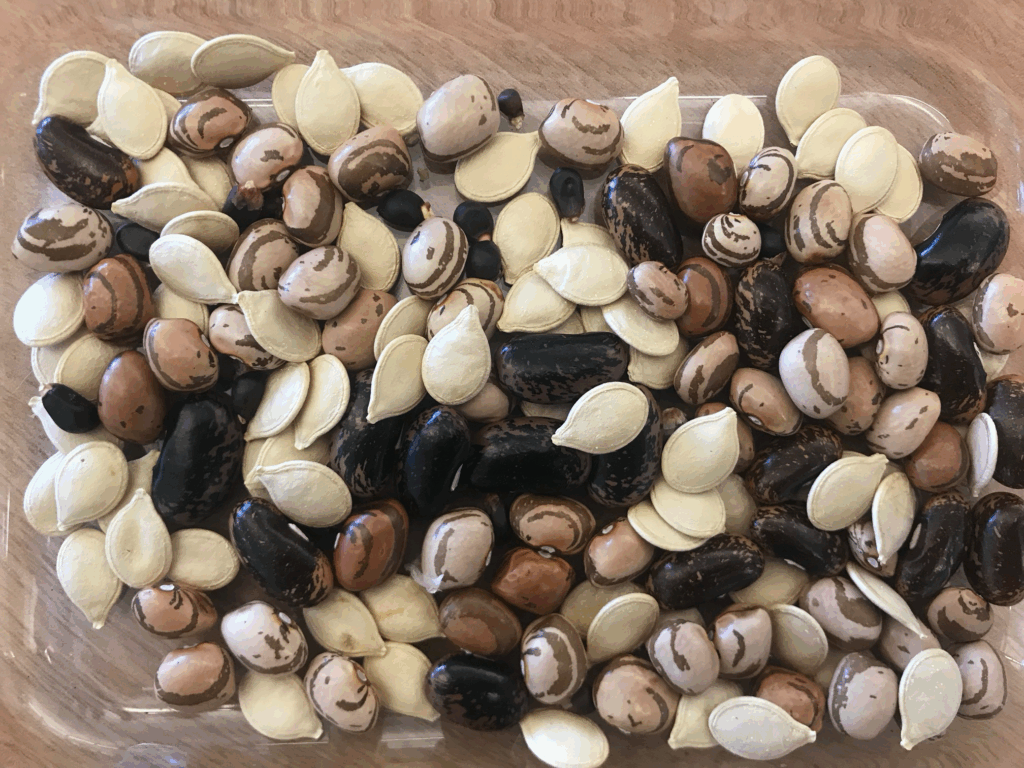
Part 2: Seed Introduction
Hold each type of seed in your palm. As Kimmerer writes, feel how they “rest in your palm as if they belong there” (p.139). Notice each seed’s shape, size, color, and texture.
Kimmerer tells us that corn seeds were traditionally soaked overnight, and in the morning, any that floated were set aside as “lazy seeds” that wouldn’t grow well. Beans were recognized for their distinctive markings, each variety telling a different story of its origins.
Part 3: Awakening the Seeds
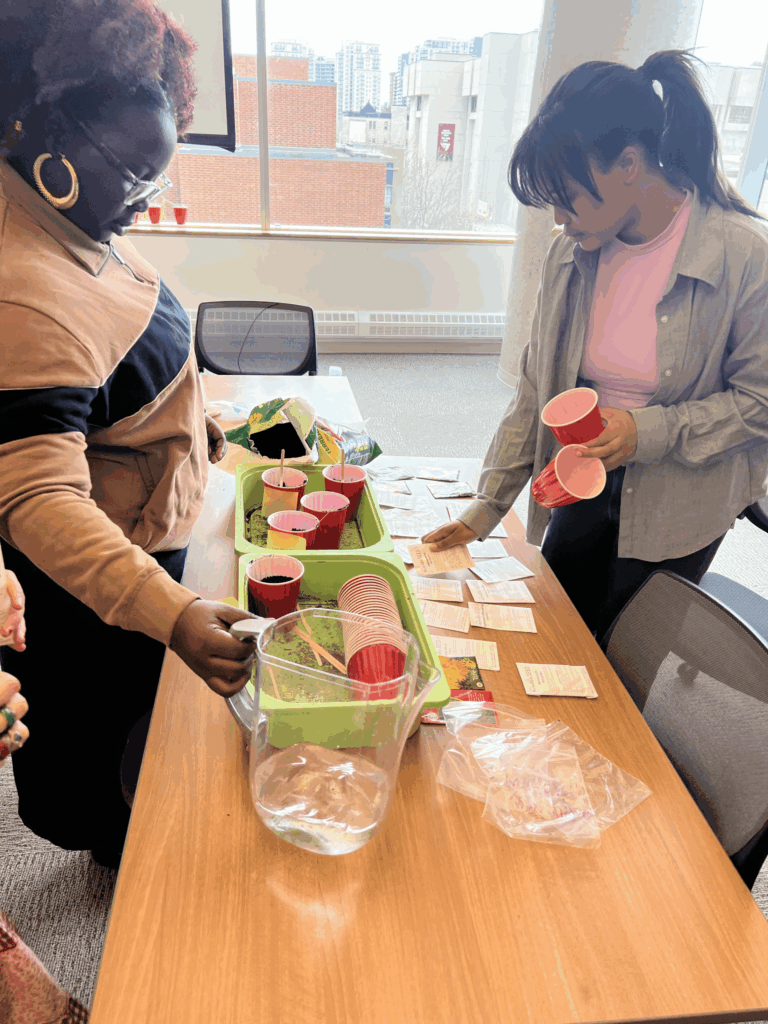
Activity: Germinating seeds with Intention
Take a moment to consider if you have space to grow a plant at home.
- Choose a seed
- Take a container and create drainage holes at the base.
- Add soil to the container
- Water your soil
- Once the soil is moist, create a hole in the soil, place your seed in it and cover it with soil.
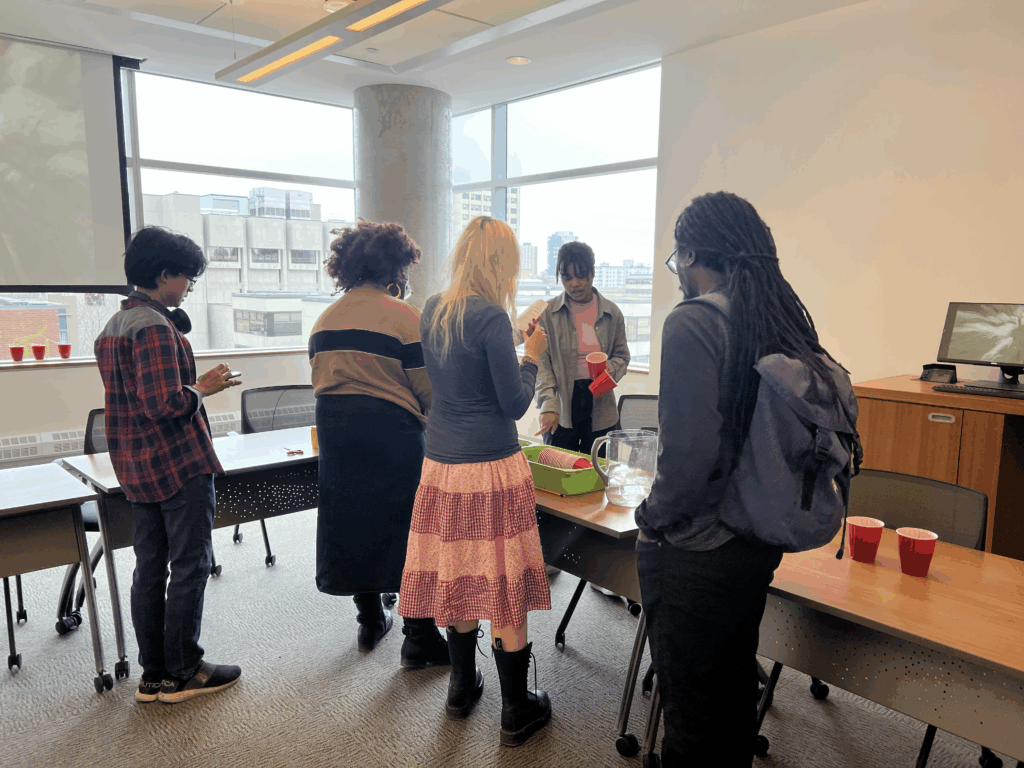
Part 4: Witnessing Emergence (Ongoing)
Activity: Take a photo today and tag us on Instagram/Facebook (@planthropolab) throughout your plant’s growth journey.
Part 5: Considering Reciprocity
In “Braiding Sweetgrass,” Kimmerer tells us about the Honorable Harvest, indigenous principles that govern our relationship with the natural world. She explains that taking a life, even a plant life, creates a moral debt that must be repaid. The very first rule is to ask permission before taking. The last is to give thanks for what has been given.
She also shares the story of Skywoman, the first human in Haudenosaunee creation stories, who fell from the sky world onto the back of a turtle. The animals brought mud from the ocean floor for her, and she danced in gratitude, spreading the soil to create Turtle Island (North America). From the soil grew the Three Sisters, who continue to sustain human life today. This story reminds us that our relationship with the earth began with a gift that requires gratitude and reciprocity.
Concluding Thoughts
In “Braiding Sweetgrass,” Kimmerer shares a moment when she realized that her Three Sisters garden was not just feeding her family but teaching them. She writes about watching her daughters carefully tending the plants, observing how the beans curled perfectly around the corn stalks, and noticing how the squash leaves unfurled to catch the morning dew. The garden became a teacher of relationship and responsibility.
Remember that germinating seeds is not just a technical process but the beginning of a relationship that humans and plants have been nurturing for thousands of years. By awakening these seeds, you’ve joined an ancient conversation and accepted responsibility for their care.
As Kimmerer reminds us, “Paying attention is a form of reciprocity with the living world (p.222).” Your attention to these seeds honors the long lineage of careful cultivation that has allowed these plants to feed humanity for generations. Your care continues a covenant between people and plants, one based not on exploitation but on mutual flourishing.
In the words Kimmerer attributes to her Indigenous elders: “Plants know when you’re talking to them (p.156)” Speak to your seeds, tend them with love, and listen carefully to what they have to teach you about patience, generosity, and the endless cycle of giving and receiving that sustains all life.
While we might read about such ideas and discuss them, as is so often done in academic institutions, sometimes there is a need also to balance this out through inhabiting, living, and being. Plants, and engagement with them can remind us what it means to vegetate, to grow, to eat light and nutrients, to give, to reproduce, to make do, to perish even. So rather than serve as yet another forum for discussion, this installation sought to move us elsewhere- into the realm of drawing to see (Causey 2017) and kinesthetic attunement (Myers 2019).
References:
Causey, Andrew. Drawn to See: Drawing as an Ethnographic Method. University of Toronto Press, 2017.
Kimmerer, R. W. (2013). Braiding Sweetgrass: Indigenous Wisdom, Scientific Knowledge, and the Teachings of Plants. Milkweed Editions.
Myers, N. (2014). Sensing Botanical Sensoria: A Kriya for Cultivating Your Inner Plant. Centre for Imaginative Ethnography.
Myers, N. (2015). Conversations on Plant Sensing: Notes from the Field. NatureCulture, 3, 35-66.
Myers, N. (2017). From the Anthropocene to the Planthroposcene: Designing Gardens for Plant/People Involution. History and Anthropology, 28(3), 297-301.